SDR OTA Deployment Framework
Docker/Git container deployment with robot profiles, so navigation, elevator and docking modules update without code changes.
Period 2025.01 – present · Affiliation KETI (national R&D project on SDR domain service business model development and robot implementation/verification) · Role OTA deployment framework design and implementation, Robot Profile structure design, per-function verification
Background and Problem
As the number of field robots grows and their functions change, modifying and reinstalling code on each robot makes maintenance impossible. To realize the SDR (Software-Defined Robot) paradigm — extending functionality through software updates after release, as with smartphones or SDVs (Software-Defined Vehicles) — a system was needed that reduces hardware dependence and updates software remotely.
Approach

- Container modularization: Split robot functions (Navigation, Patrol, Elevator, Docking) into container units based on Docker and Git, and built OTA scripts that automate backup → stop → clone → restart. The robot PC holds only a Host OS and Docker Engine, and ROS 2 containers are deployed sequentially.
- Separation of shared code and Robot Profile: So that robots deployed from the same image can still have different navigation, boarding, and docking behaviors, per-robot differences were separated into a Robot Profile (YAML) on an external volume. The key point is decoupling the lifecycles of code and parameters.
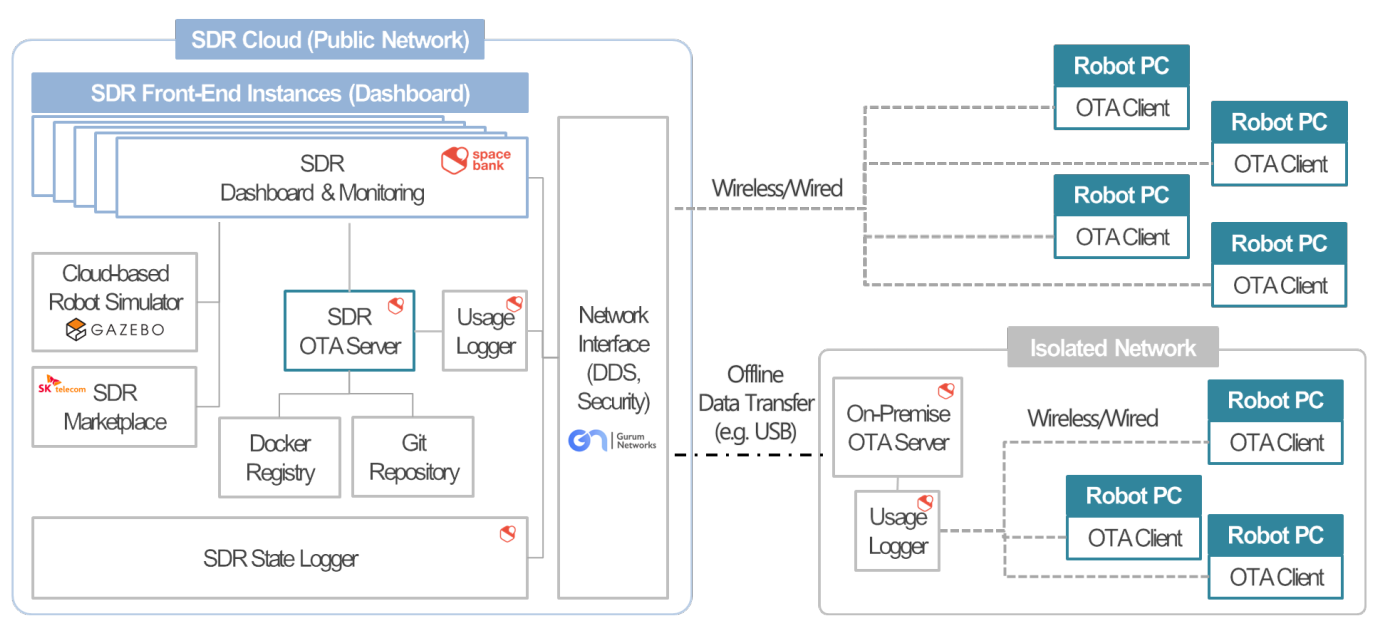
- Dual server: Designed a structure supporting both a public cloud OTA server and an On-Premise server for isolated networks, and added a State Logger for debugging and a Usage Logger for billing and subscription management.
- Phased verification: After OTA deployment, the Navigation and Patrol functions (2026.02) and the Elevator and Docking functions (2026.03) were verified without code modification.
Results
- Verified on a real robot (TETRA_S) a zero-downtime deployment structure that swaps and manages service modules (patrol, docking, elevator) without source modification.
- Completed a PoC with two shell scripts for initial installation and updates, and presented it at ICCAS 2025 (second author) (Kim et al., 2025).
- The elevator integration and LiDAR marker docking functions operate on top of this deployment system.
Tech Stack
Docker · Git / GitHub · ROS 2 Humble · Robot Profile (YAML, external volume) · Bash · DDS · TETRA_S / Jackal