Multi-Robot Anomaly Detection
Fault injection on a 30-robot fleet, rule-based detection with a web dashboard, then Transformer self-supervised detection (Aff-F1 0.94).
Period 2025.03 – 2026.05 · Affiliation KETI (multi-robot cooperative navigation national R&D project) · Role Fault injection and logging system development, anomaly detection framework design, model training and evaluation, web visualization
Background and Problem
In environments dense with multiple robots, a small fault in an individual robot (sudden battery drop, localization failure, navigation control failure) can propagate into fleet-wide bottlenecks and collisions. However, existing RMF focuses on visualizing individual robot states and lacked the means to diagnose inter-robot dependencies or cooperation failures, and threshold-based detection struggled to capture the irregularity of real anomaly data.
Approach
Phase 1 — Fault Injection and Data Collection
- Built a PySide6 Fault Injection GUI that injects and recovers hardware (battery, wheel), Localization Lost, obstacle, and sensor (LiDAR, camera) faults on simulated robots.
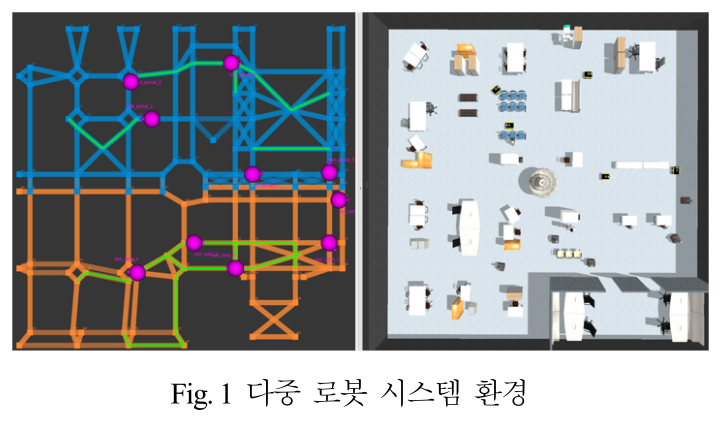
- Built a system that logs multi-robot information into a unified ROS 2 CSV (30 robots, 10 Hz downsampled to 1 Hz), later used as training data.
Phase 2 — Rule-Based Anomaly Detection and Web Visualization (ICCAS 2025) (Kim et al., 2025)

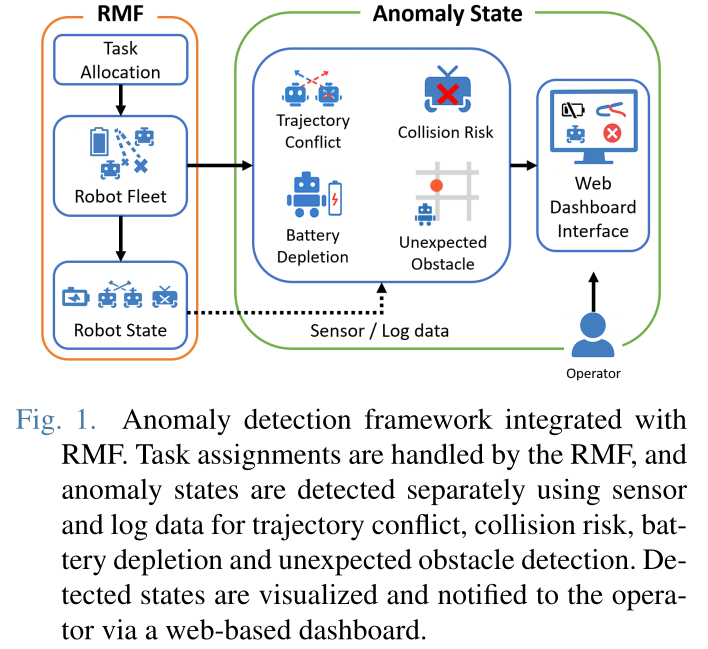
- Defined four anomaly types at the individual robot level (Battery Depletion, Obstacle Detection) and the fleet level (Trajectory Conflict, Collision Risk — paths crossing within 0.2 m of another robot).
- In a modular structure where RMF handles task allocation and a separate sensor/log-based module handles anomaly detection, a WebSocket/ROS Bridge-based web dashboard delivered real-time alerts and visualization to the operator. Verified in a 30-robot Gazebo environment.
Phase 3 — Learning-Based Anomaly Detection (ICROS 2026) (Kim et al., 2026)

- Normalized each robot’s time series into a 4-dimensional feature \(X_t = [P_t, V_t, B_t, R_t]\) (position error, velocity, battery, mission progress).
- After LSTM time-series prediction and Transformer AutoEncoder reconstruction-based detection, adopted RESTAD, a self-supervised model that embeds an RBF layer in a Transformer, to learn spatio-temporal correlations among multiple robots without labels.
- Applied it to real robots through a real-time ROS 2 streaming pipeline (based on Motion Residual).
Results
| Phase | Outcome |
|---|---|
| Rule-based (ICCAS 2025) | Real-time detection and visualization of four anomaly types, verified in a 30-robot simulation, first author, IEEE Xplore |
| Learning-based (ICROS 2026) | Region-level Aff-F1 0.94 — outperforming LSTM and a plain Transformer, first author |
| Operational visibility | PySide6 integrated fleet management GUI + Fault Injection GUI + web dashboard |
Tech Stack
Open-RMF · ROS 2 · Gazebo · PySide6 / rclpy · WebSocket / ROS Bridge · PyTorch (LSTM, Transformer AE, RESTAD) · CSV logging
References
2026
- A Learning-based Anomaly Detection Framework for Multi-Robot SystemsIn Conference of the Institute of Control, Robotics and Systems (ICROS 2026), Jul 2026
2025
- Anomaly Detection and Visualization Framework for Multi-Robot Systems Using RMFIn 2025 25th International Conference on Control, Automation and Systems (ICCAS), Nov 2025