Robot Coordinate Systems and Euler Angles
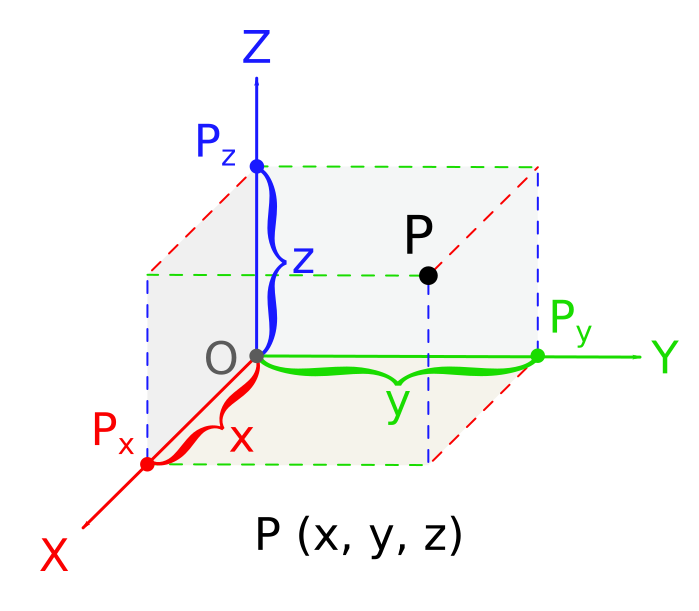
- Coordinate systems are one of the important concepts in robotics because they represent positions in the space a robot moves through.
- To perform tasks such as motion control, localization, and mission execution, a robot must know its current position and target position precisely.
- A lack of this information can cause various problems, such as collisions for mobile robots or safety issues for industrial robots.
- Robots use a variety of coordinate systems. This post covers the types of coordinate systems, their differences, and their characteristics.
- Although not a coordinate system itself, Euler angles are also covered.
Orthogonal coordinates
Cartesian coordinate system
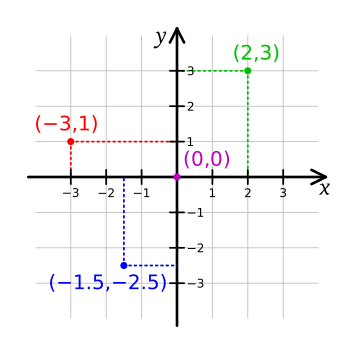
The Cartesian coordinate system is the most commonly used way of representing a point in space in geometry, and it is the basic coordinate system we are all familiar with.
- 2D coordinate system
- Represents a point on a plane. The system consists of a horizontal x-axis and a vertical y-axis.
- A point’s position is written as (x,y).
- 3D coordinate system
- Represents a point in space. The system consists of a horizontal x-axis, a vertical y-axis, and a z-axis perpendicular to the plane formed by the x and y axes.
- A point’s position is written as (x,y,z).
Polar coordinate system
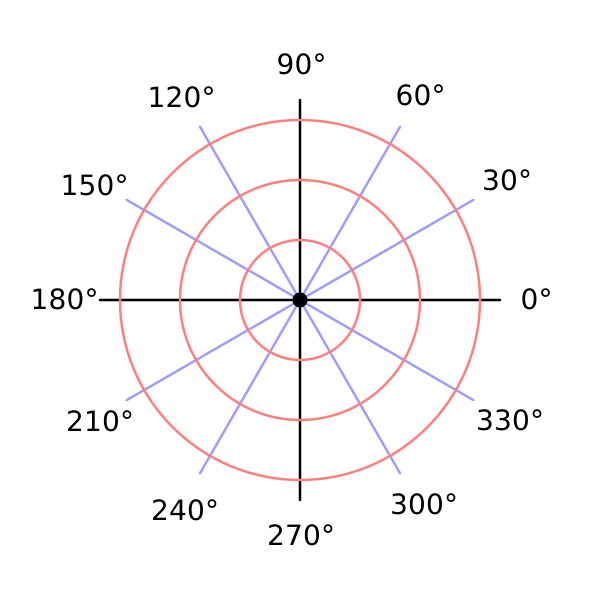
The polar coordinate system represents a point on a plane by a radius and an azimuth angle, and it can be converted to Cartesian coordinates using trigonometric functions.
- Radius (r) : the distance from the origin to the point.
- Azimuth (θ) : the angle measured from the positive x-axis, in radians or degrees. (Radians are generally used.)
A point is therefore written as (r,θ), and converting to Cartesian coordinates gives (r * cos(θ) , r * sin(θ)). Polar coordinates are effective for problems with circular symmetry and are frequently used in engineering fields such as gravitation and electromagnetism.
- Conversion from polar to Cartesian coordinates :
Cylindrical coordinate system
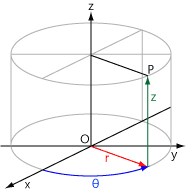
The cylindrical coordinate system expresses a point’s position by its distance from the origin, an azimuth angle, and a height.
- Radius (r) : the horizontal distance from the origin; the straight-line distance between the origin and the point.
- Azimuth (θ) : the angle measured from the positive x-axis, in radians or degrees.
- Height (z) : the vertical distance from the origin.
A point is therefore written as (r,θ,z). It is often used to describe cylinders and cylindrical structures, and in physics, engineering, and computer graphics.
- Conversion from Cartesian to cylindrical coordinates :
- Conversion from cylindrical to Cartesian coordinates :
Spherical coordinate system
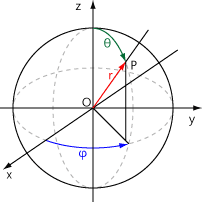
The spherical coordinate system defines a point’s position by its distance from the center of a sphere, an azimuth angle, and a polar (elevation) angle. It is defined in 3D space and is used to place points on a sphere.
- Radius (r) : the distance from the center of the sphere to the point.
- Azimuth (θ) : the angle measured from the positive x-axis. Radians are generally used.
- Polar angle (φ) : the angle measured from the x-y plane. Also generally expressed in radians.
A point is therefore written as (r,θ,φ). Since spherical coordinates represent a point on a sphere, they are useful for analyzing celestial bodies such as the Earth or the Sun, and are frequently used in astronomy.
- Conversion from Cartesian to spherical coordinates:
- Conversion from spherical to Cartesian coordinates:
Euler Angle
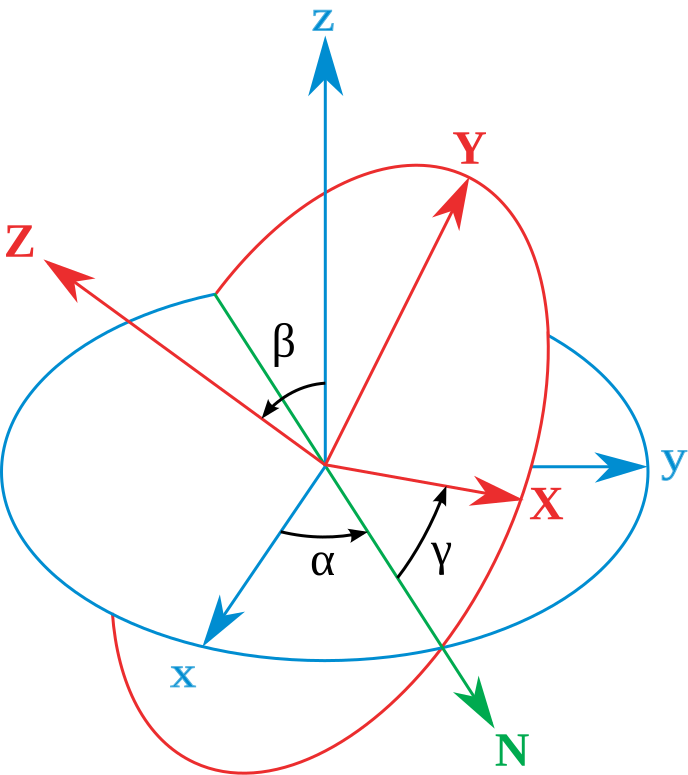
So what are the Euler angles mentioned in robotics? Euler angles describe the orientation of a rigid body as rotations of a 3D coordinate system. They are used together with the Cartesian coordinate system; as in the figure on the right, when the current frame is denoted by uppercase (X,Y,Z), the orientation can be expressed by ψ (psi), θ (theta), and φ (phi).
- ψ (psi) : the angle by which the x-y plane is rotated about the z-axis
- θ (theta) : the angle by which the z-y plane is rotated about the rotated x-axis (N-axis)
- φ (phi) : the angle by which the x-y plane is rotated about the rotated z-axis (Z-axis)
Alternatively, considering only rotation about each individual axis, rotation about the X-axis is called roll, rotation about the Y-axis pitch, and rotation about the Z-axis yaw.
The difference between Euler angles and quaternions will be covered in a future post.